
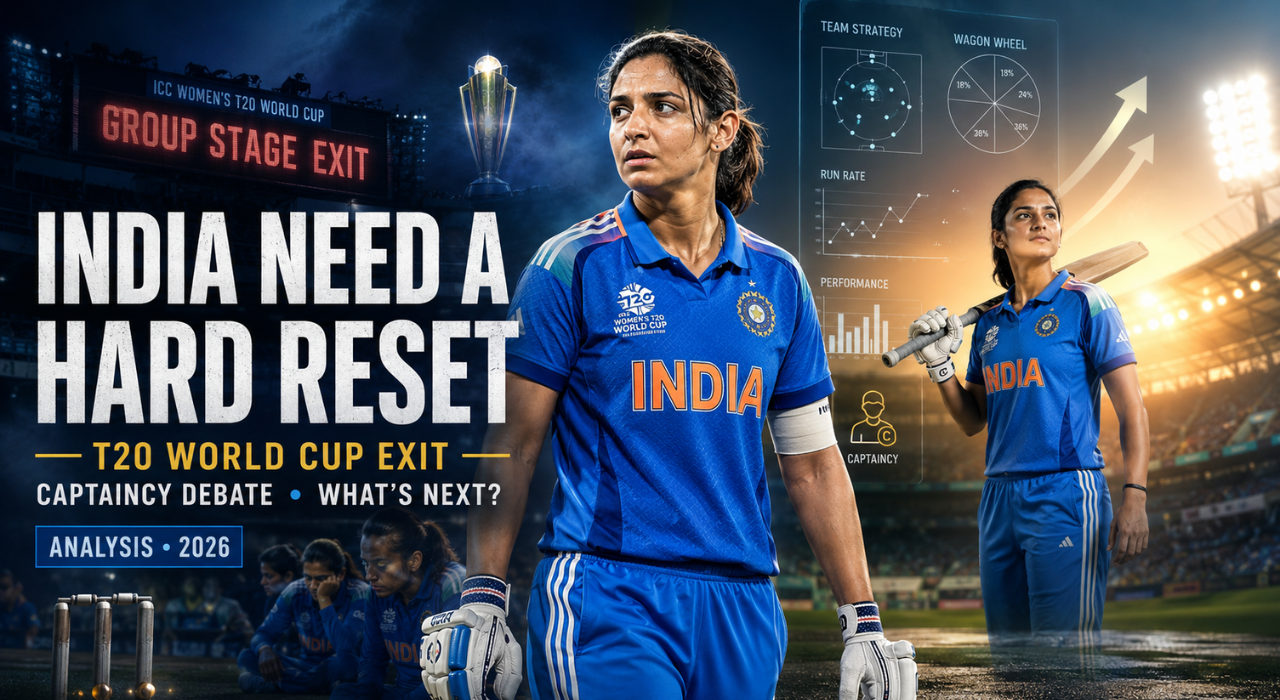
For the second T20 World Cup running, India have fallen short of the knockout stage under Harmanpreet Kaur, and the gap between this team’s potential and its results is becoming impossible to ignore. Look at the list of sides India have actually beaten across the last two editions of the tournament: Pakistan, Sri Lanka, the Netherlands, Bangladesh. That’s it. For a unit that has only grown stronger on paper since the WPL began transforming the depth and quality of Indian women’s cricket in 2023, the team has somehow ended up adding up to less than its individual parts. Two World Cups, two early exits, despite India now being recognised as one of the genuine powers of the women’s game.
It’s worth remembering that the team’s struggles in this format shouldn’t be read through the lens of the ODI World Cup triumph from less than a year ago. T20 cricket moves at a different speed, and the structure of this tournament is brutally unforgiving: drop one game and you can find yourself needing to win every remaining fixture just to stay alive. That’s precisely the corner India painted themselves into heading into their final league match against Australia, in both of the last two World Cups, and on both occasions they couldn’t get over the line.
The pattern of how they got there has shifted slightly each time. Two years ago it was an opening-game defeat to New Zealand that derailed the campaign. This time, a string of fielding errors against South Africa proved costly, badly denting India’s qualification hopes before the business end of the tournament even arrived.
Harmanpreet herself didn’t hold back when assessing where things went wrong. “If I have to think about the entire tournament, I think we didn’t play well against good teams and as a group we really need to rethink what we need to do against them,” she said after the loss to Australia ended India’s campaign. “Sometimes we were in the game but in the last few overs we gave away easy runs and if we were chasing we were not able to get those runs while batting.”
That word rethink kept surfacing, and it wasn’t pointing at a single fix. Take the Australia game itself: with the middle order having wobbled repeatedly in earlier matches, Smriti Mandhana opted for a watchful innings, ticking along at roughly run-a-ball until she was run out. Chasing an above-par score against a side like Australia demanded more urgency, yet India were stuck at 134 for 2 after 18 overs. Harmanpreet eventually dragged the innings out of its rut, but no other batter really backed her up.
The constant reshuffling of Jemimah Rodrigues and Yastika Bhatia between the No. 3 and No. 5 slots told its own story; neither player has ever had a settled role. Rodrigues has spent virtually her whole T20I career batting at three but was repeatedly moved out of that spot, while Bhatia, five years and 26 games into her international career, has never nailed down either position. Head coach Amol Muzumdar echoed his captain’s assessment when he addressed the media: “I think we really have to rethink our strategy or our T20 game.”
The bowling unit offered little more clarity. India never settled on a consistent pace combination, with no quick bowler handed more than two matches in a row and perhaps unsurprisingly, none of them stood out as a result. Even in English conditions that typically reward swing bowling, India’s pacers struggled to make an impact either in the powerplay or at the death. Compare that to bowlers like Fatima Sana, Marizanne Kapp, Aaliyah Alleyne and Kathryn Bryce, who picked up wickets regularly through the tournament for their respective sides India’s best return from a pace bowler all tournament was just three wickets, managed by Nandani Sharma.
The end of a World Cup cycle is usually the moment teams use to take stock and plan for what comes next. India’s men’s setup recently showed how ruthless that process can be, dropping a T20 World Cup-winning captain in Suryakumar Yadav purely on the basis of form, and turning instead to Shreyas Iyer on the strength of his IPL captaincy résumé, despite his having gone over two years without playing a T20I.
That brings the conversation back to Harmanpreet. At 37, with two consecutive group-stage exits as captain in World Cups, the obvious question is whether she remains the right person to lead this team into the next cycle. If the selectors do feel a change in leadership is needed, this is the natural point to make it, giving a successor a real runway rather than a partial trial even though Muzumdar has indicated he wants Harmanpreet to stay on as captain. The WPL has also handed selectors a ready-made alternative in 29-year-old Smriti Mandhana, who has won the league title twice in four seasons leading Royal Challengers Bengaluru and already has 18 T20Is as India captain under her belt, with 11 wins from those games.
None of this means India should be looking to move on from Harmanpreet the batter. It was her innings alone that got India to 170 against Australia. Keeping her in the side as a player, even without the captaincy, could give Mandhana an experienced voice to lean on while the team works out who eventually replaces Harmanpreet in the middle order.
There isn’t much time to dwell on what’s gone before. The Asian Games are only a few months away, the Champions Trophy follows early next year, and the Olympics and the next T20 World Cup arrive in 2028. The past, as it stands, is already written. What India does with the rethink is what matters now.
Read more: India Women Crash Out of T20 World Cup After Australia Defeat
