
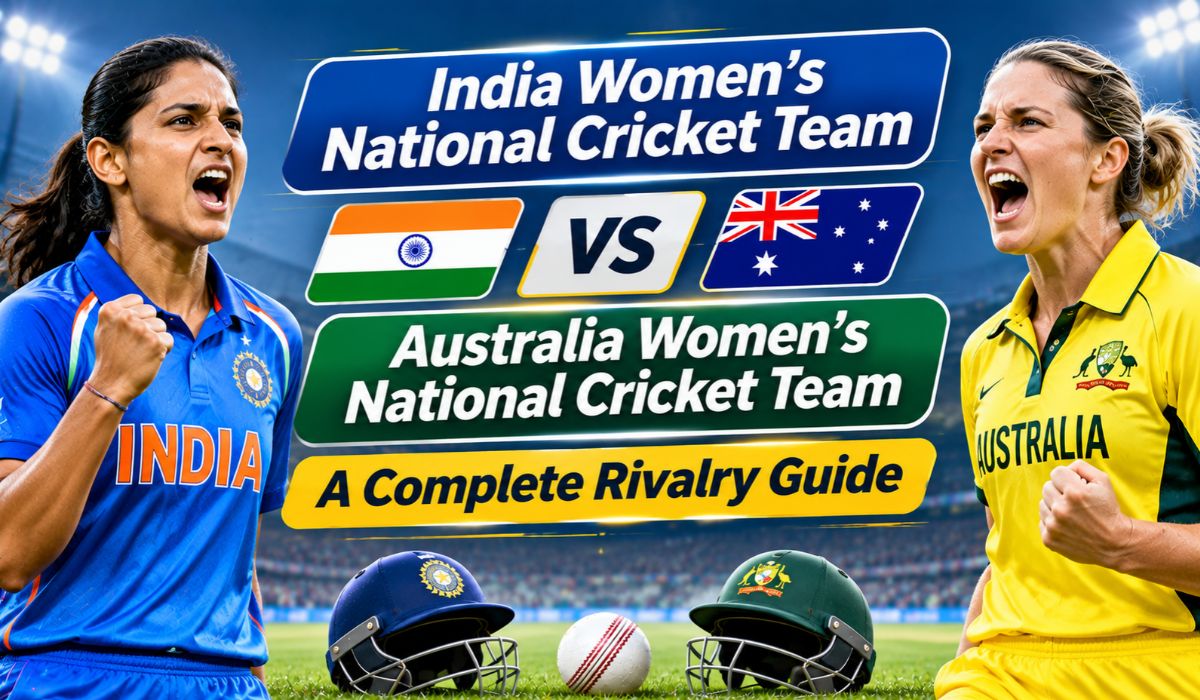
The India Women’s National Cricket Team vs. Australia Women’s National Cricket Team rivalry is currently being followed closely by many fans of modern women’s cricket. For more than 10 years now, the India Women’s National Cricket Team vs. Australia Women’s National Cricket Team matches have been characterized by exciting finishes, impressive individual records, and high levels of competition in bilateral and ICC tournaments.
Whether it is a T20 World Cup knockout match or a bilateral ODI series, fans of each country look forward to each installment of the India Women’s National Cricket Team vs. Australia Women’s National Cricket Team clash.
A Rivalry Built Over Decades
Australia has traditionally dominated women’s cricket by winning several ICC Women’s World Cups and T20 World Cups. Conversely, India has become a serious threat to Australia in the past decade, having reached the final or semi-final of most major tournaments. This increased rivalry is why there is such high levels of anticipation before each scheduled match between the Indian Women’s National Cricket Team and the Australian Women’s National Cricket Team.
The last full bilateral tour for the Indian Women’s National Cricket Team was in Australia from February through March of 2026. The tour included a multi-format series, which had three T20Is, three ODIs and one one-off Test match. This bilateral tour is generally considered to be one of the best representations of the rivalry between the Indian Women’s National Cricket Team and the Australian Women’s National Cricket Team in recent history because it provided each side with an opportunity to test their abilities in every format of the game.
2025–26 Tour: Full Breakdown
The first match of the Test series was played in Australia, which resulted in a win for the home team by a margin of 1-0. In addition, Australia took all three games of the One Day International (ODI) series to win 3-0. On the other hand, India was able to come back from being down 0-3 in the ODI series and take two out of three matches in the Twenty20 International (T20I) series to win 2-1. Annabel Sutherland was named Player of the Series for Australia. As a result of this split outcome, Australia ended up having 12 series points as opposed to India’s 4 under the points-based system that determined the winner of the tour.
Australia won the Test Match and ODI Series, however, India took home the T20I Series; Harmanpreet Kaur became the first female cricketer to play the most International Matches during this tour. Australia evened out the T20I Series after winning the last match of the series by 19 runs due to Georgia Voll’s 88 runs. India answered back and sealed the T20I Series with a 17 run win led by Smriti Mandhana’s 82 runs.
In many ways, this series was a prime example of the unpredictability that defines the India women’s national cricket team vs Australia women’s national cricket team rivalry. The Australian team had much greater experience and success in red-ball and 50-over cricket, while the Indian team possessed the power to win in the shortest version of the game.
2026 T20 World Cup Clash
The India Women’s National Cricket Team vs. Australia Women’s National Cricket Team was not limited to bilateral series, but rather was showcased on the grandest of stages: The ICC Women’s T20 World Cup 2026, hosted in England. At Lord’s Cricket Ground in London, England, on June 28, 2026 during the Group Stage of the tournament, Australia defeated India by six wickets with six balls to spare; chasing down India’s total of 170/4, Australia posted a total of 172/4.
With both Ellyse Perry and Ashleigh Gardner scoring half-centuries, it was enough to send India home early from the Women’s T20 World Cup, despite the fact that India set a record for the highest score they’ve ever recorded against Australia in a Women’s T20 World Cup game. This suggests that while India can raise its game to a high level, Australia’s depth and ability to remain calm and collected under pressure are what make them a tough opponent during the critical stages of the India women’s national cricket team vs Australia women’s national cricket team matches.
Historical Head-to-Head Overview
The Indian Women’s National Cricket Team versus the Australian Women’s National Cricket Team rivalry has developed over several decades through numerous series and tours.
During India’s 2021-22 trip to Australia, the only Test match played ended in a draw (0-0). Australia defeated India in the three-match One Day International (ODI) series by a margin of 2-1. Australia defeated India in the three-match Twenty20 International (T20I) series by a margin of 2-0. Tahlia McGrath was named the player of the series for the entire tour. Overall, Australia earned 11 series points to India’s five.
Australia’s 2022-23 tour of India resulted in a five game T20I series where Australia defeated India 4-1. One of these games was decided through a Super Over, which made this one of the most exciting series between the Indian women’s national cricket team and Australian women’s national cricket team played on Indian soil.
In December 2024, India traveled to Australia to play a three-game ODI series, in which Australia swept the series 3-0. Sutherland once again earned Player of the Series honors. Additionally, during this series, Australia set the record for the highest score allowed by India in a Women’s ODI.
The results demonstrate a trend where Australia has dominated all forms of the game; however, India is closing the gap with each match, especially in T20 cricket, thus providing an exciting spectacle for each India Women’s National Cricket Team vs Australia Women’s National Cricket Team Series.
Head-to-Head Summary Table
| Series/Tour | Format | Result | Key Performer |
| 2025–26 (Australia) | Test (1 match) | Australia won 1–0 | Annabel Sutherland (Aus) |
| 2025–26 (Australia) | ODI (3 matches) | Australia won 3–0 | Annabel Sutherland (Aus) |
| 2025–26 (Australia) | T20I (3 matches) | India won 2–1 | Smriti Mandhana / Georgia Voll |
| 2026 T20 World Cup | T20 (Group Stage) | Australia won by 6 wickets | Ellyse Perry, Ashleigh Gardner |
| 2024–25 (Australia) | ODI (3 matches) | Australia won 3–0 | Annabel Sutherland (Aus) |
| 2022–23 (India) | T20I (5 matches) | Australia won 4–1 | Decided via Super Over in one match |
| 2021–22 (Australia) | Test (1 match) | Drawn 0–0 | — |
| 2021–22 (Australia) | ODI (3 matches) | Australia won 2–1 | Tahlia McGrath (Aus) |
| 2021–22 (Australia) | T20I (3 matches) | Australia won 2–0 | Tahlia McGrath (Aus) |
The table above shows why the India Women’s National Cricket Team vs. Australia Women’s National Cricket Team match is a good way to see how much progress India has made in Women’s Cricket — Australia is better in longer format games, but India has shown some of their potential, particularly in T20 Cricket, which is a shorter version of the game.
Why This Rivalry Matters So Much
There are numerous other factors that make the rivalry between the India Women’s National Cricket Team and the Australia Women’s National Cricket Team so significant, other than simply who wins or loses each match. For one thing, there are many of the world’s most talented female cricketers on both teams. Some examples of these players include Harmanpreet Kaur, Smriti Mandhana, Shafali Verma, and Jemimah Rodrigues from India, and Ellyse Perry, Ashleigh Gardner, Beth Mooney, and Annabel Sutherland from Australia. Therefore, whenever the India Women’s National Cricket Team plays the Australia Women’s National Cricket Team, it is an opportunity to see how each player performs at their highest level.
The growth of the India women’s national cricket team vs Australia women’s national cricket team matches’ television audience as well as the attendance at these events has significantly increased over the past several years, which reflects the overall expansion of women’s cricket on a global scale, largely due to the establishment of such leagues as the Women’s Premier League (WPL) in India and the Women’s Big Bash League (WBBL) in Australia, where players from each country can compete with or against each other.
Every India women’s national cricket team vs Australia women’s national cricket team series has direct impact on the ICC rankings, World Cup qualifying process, and the ICC Women’s Championship points table. As every match is worth points towards a team qualifying for major international competitions, the importance of each game is increased.
Key Factors That Often Decide the Outcome
The Australian team usually features a more extensive batting order than the Indian team, enabling them to come back from early losses. This ability to recover has proved critical in many India women’s national cricket team vs Australia women’s national cricket team games.
India has a major advantage over Australia when it comes to spin bowling because of the type of pitches they play on, which tend to be slow and turn easily.
The level of intensity with which Australia fields has often been the factor that determines who wins the close matches between the two teams.
In addition, some of the most consistent players for both teams – Harmanpreet Kaur (India) and Ellyse Perry (Australia) – are often at their best when the stakes are highest.
The conditions of a home-ground advantage (pace and bounce in Australia vs. spin friendly surfaces in India) are very important factors when determining how every India women’s national cricket team vs Australia women’s national cricket team series will be played out.
What’s Next for This Rivalry
The India women’s national cricket team vs Australia women’s national cricket team rivalry will continue to grow as young talent continues to develop in both countries. In addition, the two boards have invested heavily in women’s cricket infrastructure, so fans should be able to watch more frequent India women’s national cricket team vs Australia women’s national cricket team matches over the next several years. These include bilateral series, ICC Women’s Championship matches, and knockout matches during global tournaments.
Explore women’s cricket news, player profiles, match scorecards, records, and statistics at Female Cricketer.
Frequently Asked Questions
1. Who has won more matches in the India women’s national cricket team vs Australia women’s national cricket team rivalry overall?
In past history, Australia has had an advantage over all formats of cricket, specifically Test cricket and One-Day International (ODI) cricket, but India is closing the gap on Australia with its recent performances in Twenty20 International (T20I) cricket.
2. What was the result of the most recent bilateral series between the two teams?
Australia won the Test series 1–0 and the ODI series 3–0, and India won the T20I series 2–1 during the 2025–26 Australian tour.
3. Did India ever beat Australia in the T20 World Cup 2026?
No, in the group stage match played on June 28th, 2026, at Lord’s, Australia won against India by six wickets, even though India scored the most runs they have ever scored in a single game against Australia during the tournament’s history.
4. Who were the standout players in the latest series between the two sides?
In addition, Annabel Sutherland was named Player of the Series for Australia during their 2025-26 tour, and Smriti Mandhana and Georgia Voll each contributed key fifties in the T20I section of the series.
5. Has there ever been a Super Over in this rivalry?
During the 2022-2023 T20I series in India, one of the five matches played by each team ended up being decided through a Super Over, where Australia ultimately won the series 4-1.
6. Why is the India women’s national cricket team vs Australia women’s national cricket team match considered so important?
The fact that these two teams are both considered as some of the best teams currently playing women’s cricket means that all matches played between the two will be seen as major events in the world’s cricket calendar. This is primarily due to the impact that each match has on each team’s ranking within the International Cricket Council (ICC) and also because they help determine who qualifies for the World Cups.
