
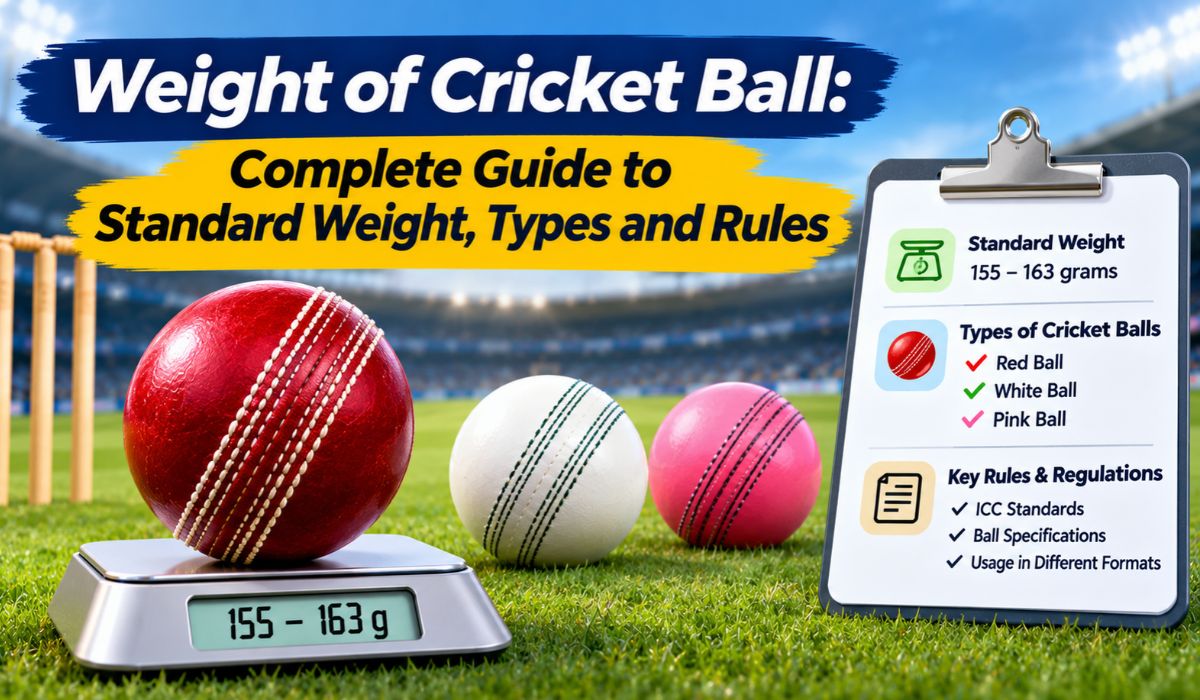
Cricket is a game with very little margin for error; the weight of the cricket ball is a subtle factor in the outcome of each delivery, hit, and catch. Knowing the weight of the cricket ball will give you a better understanding of how the game works whether you are a young player purchasing your first leather ball, a coach developing practice drills, or a fan interested in learning more about the sport.
This article will provide you with information on the official specifications, differences among men’s, women’s, and youth balls, manufacturing processes of the balls, and how the weight affects players’ performance.
What Is the Standard Weight of Cricket Ball?
The Marylebone Cricket Club (MCC), through its Laws of Cricket, clearly states what specifications a cricket ball must meet. In terms of senior men’s cricket, the maximum allowed weight for a cricket ball is 163 grams and the minimum allowed weight is 155.9 grams, or approximately 5.75 and 5.5 ounces, respectively. In terms of diameter, the ball cannot exceed 229 mm nor can it fall below 224 mm, or approximately 9 and 8.81 inches, respectively. Any ball that falls outside of both of these ranges may not be used in an official game of cricket.
Most match balls available on the market today fall within a relatively narrow weight range (156-160 grams). There are several factors contributing to this small variability. One of the main reasons is that the natural materials used to produce these balls (cork, wool, twine and leather) can’t be manufactured with complete consistency.
Read Also:- Zimbabwe Women’s National Cricket Team vs India Women’s National Cricket Team Match Scorecard
Weight of Cricket Ball by Category
Different age groups and both sexes use different sized/weight balls when playing cricket. The below table shows the official guidelines for ball size/weight set out in the Laws of Cricket.
| Category | Weight (grams) | Weight (ounces) | Circumference (mm) | Circumference (inches) |
| Men’s senior | 155.9 – 163 | 5.5 – 5.75 | 224 – 229 | 8.81 – 9.0 |
| Women’s | 140 – 151 | 4.94 – 5.31 | 210 – 220 | 8.25 – 8.65 |
| Junior | 133 – 144 | 4.69 – 5.07 | 197 – 210 | 7.75 – 8.25 |
Lighter and smaller balls used by women and young people help keep the game safe and fun for everyone. Using lighter, smaller balls allows the young person to learn proper technique while avoiding injuries to the hand, wrist or shoulder.
Why Does the Weight of Cricket Ball Matter?
The weight of the cricket ball has an effect on several aspects of the game: its movement in flight, how high it bounces on the pitch, and how heavy/light it feels to the player holding the ball. A heavier ball will carry more momentum, which means that when a batsman hits it well, it will come off his/her bat with greater force and therefore go further. On the other hand, a lighter ball is easier to control/grip and throw; however, it can be influenced by wind and moisture (humidity).
Weight is also important to maintain fairness. If there were large differences in the weights of balls, bowlers who use a heavier ball would have a distinct advantage in terms of both speed and height of the bounce. On the other hand, batsmen who are facing a lighter ball would be able to hit the ball farther and more consistently. The strict regulations regarding the weight of the ball allow the competition to remain relatively even between the bat and the ball.
The safety of the players was also a factor in the development of cricket. The speed of a hard leather cricket ball can reach up to 140 kilometers per hour (km/h), which has the potential to inflict severe physical harm upon players. Consequently, it is common practice for batsmen to wear protective gear including helmets, pads, and gloves.
Read Also:- Australia Women’s National Cricket Team vs India Women’s National Cricket Team Timeline
Weight of Cricket Ball in Test, ODI and T20 Cricket
A frequent question about cricket balls is if there are differences in their weight based upon the format of the game. They do not differ. The same Law 4 limits apply to Test matches, One Day Internationals, and Twenty20 games. The only difference in the ball among the three types of games are the color of the ball, the number of balls that can be used in each game type, and when a ball may be replaced.
In Test matches (Cricket), a red-coloured ball will be used and the option to use a new ball will be given to the teams once 80 overs have been completed. In One Day Internationals (ODI) there will be two white-coloured balls which will be delivered from both ends of the pitch. A single white-coloured ball will be used in each inning of a Twenty20 (T20) match. Although there are variations in the colour and delivery methods of the balls used in the three forms of cricket, all balls produced must fall within the same weight limits.
Red, White and Pink Balls: Does Colour Change the Weight?
Red balls have been the traditional choice for test and first-class cricket matches. Limited overs matches are played with white balls, which can be seen better at night (under floodlights) and on players wearing different color uniforms. Pink balls were introduced for day/night test matches to make it easier to view the ball during evening hours.
The color on the ball is produced by a combination of dye and a clear lacquer coating over the surface of the leather. Although this coating has a minimal effect on the weight of the ball, all three types of balls must meet the same weight requirements as a standard cricket ball. However, the most significant difference between the three types of balls is how they perform: white balls usually lose their glossiness and ability to swing earlier than other types of balls, whereas pink balls are designed to retain their color for longer periods of time.
Kookaburra, Dukes and SG: Brand Differences
The three major brands that control the majority of international cricket are utilized by various countries.
- Kookaburra (Australia): this type of ball is used in Australia, New Zealand, and South Africa as well as for the majority of limited-overs cricket globally. The machine stitching on the Kookaburra causes the seam to become flat once the ball has been used for some time, making it more difficult for seam bowlers to utilize the ball to create movement off the pitch during the latter stages of an innings.
- Dukes (England): is used in England and the West Indies. The ball is entirely hand stitched with a large seam that allows the ball to be swung and seamed for a long time.
- SG (India): used in Test Cricket matches in India. The pronounced hand stitched seam assists spinners, and the wearing of the ball typically results in reverse swing.
Each brand is looking for a similar weight of cricket ball range; however, minor variations in the quality of the leather, height of the seam and type of lacquer applied will result in significantly different performance attributes.
Read Also:- Nandini Sharma Cricketer | Sarah Taylor | Chamari Athapaththu
How a Cricket Ball Is Made
At the center of a cricket ball is a core made primarily of cork (or sometimes a combination of cork and rubber). String or twine is wrapped tightly around this core until the desired size of the ball has been achieved. The ball’s outer surface is created by stitching together two hemispheres of leather, which are typically dyed and treated with grease.
In the standard design of cricket balls, there are six lines of stitching that run around the equator of the ball, three above it and three below. Bowlers use this area of the ball to hold onto the ball and make adjustments. Once the ball has been sewn, it will be pressed, polished and inspected. At this time in the process, quality control is very important. This is because the weight of the finished cricket ball must be within a certain range as specified by law. If a ball does not meet those requirements, it will be rejected.
Weight of Cricket Ball Compared With Other Sports Balls
How does a cricket ball compare to the balls used in various types of sports? The data provided in the following chart will give you a better idea of where a cricket ball stands.
| Ball | Approximate weight (grams) | Hardness |
| Cricket ball (men’s) | 155.9 – 163 | Very hard |
| Field hockey ball | 156 – 163 | Very hard |
| Baseball | 142 – 149 | Hard |
| Football (soccer, size 5) | 410 – 450 | Inflated |
| Tennis ball | 56 – 59.4 | Soft, hollow |
| Golf ball | Max 45.93 | Hard |
It’s worth noting that the weight limits of a cricket ball and a field hockey ball are virtually the same. Additionally, while a cricket ball is slightly heavier than a baseball, it is nearly three times heavier than a tennis ball, making it clear why tennis balls can only be used in casual/street cricket.
How the Weight of Cricket Ball Affects Bowling, Batting and Fielding
- Bowling: Fast bowlers rely on the ball’s mass and hardness to produce bounce and carry. Seam and swing bowlers depend on the ball’s balance, seam and surface condition. Spinners will benefit from a ball that has good grip with the pitch, so the seam quality of different manufacturers is important.
- Batting – A good shot will travel far from the bat without much effort, but if you don’t time your shot correctly it could hurt your hand. In addition to timing your shot correctly, you need to be able to tell how fast and how high the ball will bounce based upon its weight.
- Catching and throwing a baseball (approximately 160g) requires excellent skill. All infield players are required to use protective equipment including helmets and leg guards. Outfielders have been trained to accurately throw the ball a distance of 70 to 80 meters.
The heavier the ball, the slower it loses its shape and shine, this is why many bowlers/captains spend a significant amount of time keeping the ball in good condition.
Can You Measure the Weight of Cricket Ball at Home?
Yes. A digital kitchen scale with accuracy to 0.1 gram will be sufficient to check a brand new ball. Place the ball on the scale and compare the reading against the allowed range for your category. Keep in mind that a previously used ball could weigh less due to wear and tear and loss of finish, or potentially more if it has absorbed water. Therefore, the weight of cricket ball is only formally checked at the beginning of each match, when umpires examine the ball prior to commencing play.
Conclusion: Weight of Cricket Ball
The basic weights are easy to recall; 155.9-163 grams for men, 140-151 grams for women and 133-144 grams for juniors. The weights allow for fairness, safety, and consistency within all forms of the game and across the world. Knowing how much a cricket ball weighs allows players to select appropriate equipment, coaches to assign suitable balls to different age categories, and fans to understand the degree of difficulty involved with each delivery. When watching a fast bowler charging towards the crease, keep in mind that they are delivering slightly less than 160 grams of cork, string, and leather at speeds as high as 150 kilometers per hour.
Explore the latest updates, player profiles, match highlights, and achievements in women’s cricket at Female Cricketer.
FAQs: Weight of Cricket Ball
1. What is the weight of cricket ball in grams?
Men’s senior cricket uses a cricket ball that weighs from 155.9g to 163g. Women’s balls are 140-151g. Junior balls are 133-144g.
2. How many ounces does a cricket ball weigh?
The weight of a male cricket ball varies from 5.5 to 5.75 ounces. The weight of female cricket balls vary from 4.94 to 5.31 ounces. The weight of junior cricket balls vary from 4.69 to 5.07 ounces.
3. Is the standard weight the same for men and women?
No. Women’s balls are both lighter and smaller than those used by men. Women’s balls weigh 140 to 151 grams and have a circumference of 210 to 220 mm; while men’s balls weigh 155.9 to 163 grams and have a larger circumference.
4. Do red and white balls weigh the same?
Yes. Red, white, and pink balls must each fall within the same legally acceptable weight limits. The color of a ball is used for visibility and the way a ball wears down over time.
5. What is a cricket ball made of?
This is what makes up the ball: it has a center made of cork, many layers of tightly wrapped string (or twine), and a layer of leather on the outside that is sewn together using a very noticeable seam. In order to protect the leather from damage, it is dyed and then coated in lacquer.
6. How does a cricket ball compare with a tennis ball?
Cricket balls are significantly heavier and harder than tennis balls. Tennis balls typically weigh between 56 and 59 grams, whereas men’s cricket balls can weigh up to three times that much. Due to this difference in weight and hardness, tennis balls are generally only used for casual cricket.
